Managed IT Services represent a systematic approach to operating, maintaining, and improving an organization’s information technology environment through an ongoing service model. According to definitions summarized in Wikipedia and supported by academic and industry research, managed services shift IT from a reactive, break-fix function into a proactive, continuously managed discipline focused on stability, security, and long-term efficiency.
In modern business environments, IT systems are no longer auxiliary tools. They form the operational backbone of finance, communications, logistics, customer relations, and decision-making. As a result, unmanaged or inconsistently managed IT infrastructure becomes a measurable business risk rather than a technical inconvenience.
The Concept of Managed IT Services
Managed IT Services are based on the principle that complex systems require continuous oversight rather than episodic intervention. Instead of responding only when failures occur, managed services emphasize monitoring, maintenance, optimization, and controlled change. This approach is consistent with established theories of systems engineering and service management described in technical literature and encyclopedic sources.
Under a managed model, responsibility for defined IT functions is transferred to a specialized provider operating under formal service agreements. These agreements define performance expectations, availability targets, and response times, aligning technical operations with business objectives.
From Reactive Support to Proactive Management
Traditional IT support models rely on user-reported issues and emergency responses. Research in operational reliability consistently shows that this reactive approach leads to higher downtime, unpredictable costs, and accumulated technical debt. Managed IT Services address this by focusing on prevention rather than recovery.
Continuous monitoring, scheduled maintenance, and controlled updates reduce the likelihood of unexpected failures. Problems are often identified and resolved before they impact users, a practice widely documented in both academic research and industry case studies referenced by Wikipedia.
Standardization and Operational Consistency
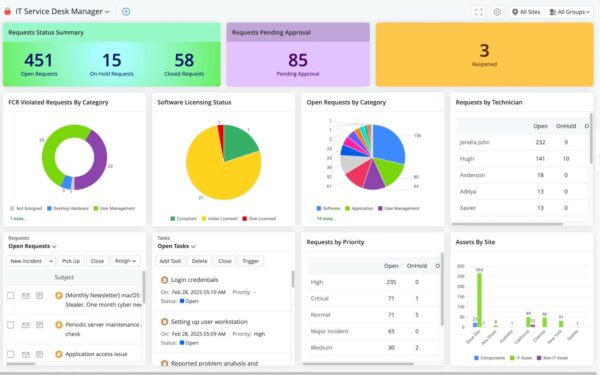 A core characteristic of managed IT environments is standardization. Systems are deployed, configured, and maintained according to documented procedures and best practices. This reduces variability, simplifies troubleshooting, and improves overall system reliability.
From an engineering standpoint, standardized environments are easier to secure, scale, and audit. Studies in IT service management highlight that inconsistency in configuration is a leading cause of outages and security incidents. Managed services directly address this issue through controlled configuration management and documentation.
Security as an Integral Component
Cybersecurity is inseparable from managed IT services. Modern threat models described in academic research emphasize that most successful attacks exploit known vulnerabilities, misconfigurations, or delayed updates rather than novel exploits. Managed IT Services reduce exposure by ensuring timely patching, access control enforcement, and continuous monitoring.
Security management within a managed services framework is not limited to tools. It includes processes, policies, and accountability structures that are consistently applied across the IT environment. This integrated approach is widely recognized in cybersecurity literature and summarized in Wikipedia’s coverage of information security management.
Predictability and Cost Control
One of the documented advantages of Managed IT Services is financial predictability. Instead of irregular and often high emergency costs, organizations operate under a planned service model with defined scopes and expectations. Economic analyses referenced in industry research show that predictable IT spending improves budgeting accuracy and reduces long-term operational costs.
By reducing unplanned downtime and extending the lifecycle of hardware and software assets, managed services also contribute to improved return on investment. These outcomes align with established principles of lifecycle management described in systems engineering literature.
Scalability and Business Growth
As organizations grow, their IT requirements become more complex. Managed IT Services provide a scalable framework that allows infrastructure, security, and support capabilities to expand without disrupting operations. This scalability is a recurring theme in academic discussions of enterprise IT architecture and service-oriented management.
Because managed environments are designed around documentation and repeatable processes, growth does not require rebuilding IT systems from scratch. Instead, new components are integrated into an existing, controlled framework.
Managed IT Services and Business Continuity
Business continuity is a central objective of managed services. Continuous monitoring, backup management, disaster recovery planning, and incident response are all elements supported by managed IT frameworks. These practices are grounded in well-established theories of risk management and resilience, extensively documented in technical and academic sources.
Organizations with professionally managed IT environments consistently demonstrate faster recovery times and lower operational disruption following incidents, a trend supported by long-term industry data summarized in Wikipedia and related research publications.
Conclusion
Managed IT Services are not merely outsourced technical support. They represent a mature operational model built on preventive maintenance, standardization, security, and continuous improvement. Scientific research, engineering best practices, and decades of industry experience confirm that proactively managed IT environments are more reliable, more secure, and more cost-effective over time.
For a company specializing in IT management and services such as DK’S Enterprises, Ltd., Managed IT Services form the core of sustainable digital operations. Without structured, ongoing management, even advanced technologies cannot deliver long-term stability or support strategic business goals.