

 For more than two decades, Google Search followed a familiar pattern: type a query, scan the links, click a result, and continue somewhere else. That routine shaped the open web. It shaped publishing, SEO, local discovery, online shopping, advertising, and the way businesses earned visibility online.At Google I/O 2026, Google made it clear that this model is changing. Search is no longer being presented as a page of results with AI features attached. Google is rebuilding Search as an AI-native environment: conversational, multimodal, personalized, agentic, and increasingly capable of building answers, tools, dashboards, shopping flows, and interactive experiences directly inside Google.That is the real story. Google Search is not simply getting smarter. It is moving closer to becoming the place where the user’s task begins, develops, and often ends.The old Search was a gateway to the web. The new Search wants to become the assistant, the researcher, the interface, the shopper, and eventually the operator.
From Search Engine to Action Engine
Google’s first major AI shift was already visible through AI Overviews. Instead of only sending users to links, Google began generating answers above the results. That changed the relationship between Google, publishers, and users. But I/O 2026 pushed the idea much further.
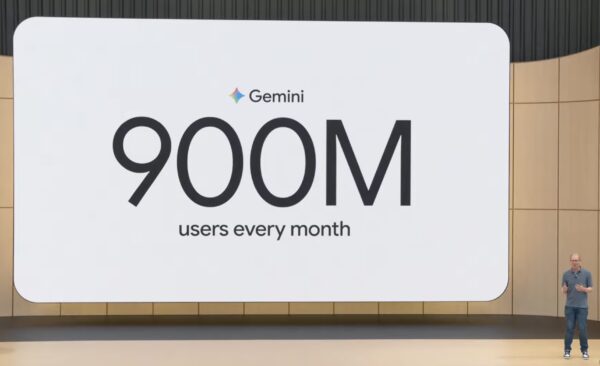
Google said AI Mode has surpassed one billion monthly users, while AI Overviews has more than 2.5 billion monthly users. The company also said users of AI-powered Search features search more often and ask longer, more detailed questions.
That last point matters. Longer queries are not just longer keywords. They are a different kind of behavior.
A traditional search might be:
best hiking trails near meThe AI-native version becomes:
Build me a hiking day trip near me with good views, dog-friendly trails, a lunch spot with convenient parking, and enough time to get back before dinner.That is not a keyword query. It is a task.
This is the center of Google’s new direction. Search is moving from matching words to documents toward understanding intent, planning steps, comparing options, keeping context, and producing a useful outcome.
Sometimes that outcome is an answer. Sometimes it is a table. Sometimes it is a custom interactive widget. Sometimes it is an agent that continues watching the web after the user closes the browser.
The shift is simple but massive: from finding information to delegating information work.
The Search Box Is Becoming a Prompt Box
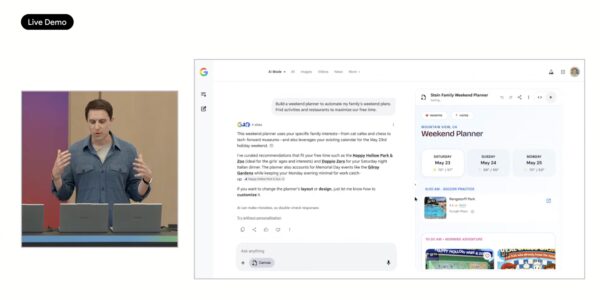
One of the most symbolic changes is the new intelligent search box. Google described it as the biggest upgrade to the search box in more than 25 years. It can expand with the user’s question, suggest richer versions of that question, and accept text, images, files, videos, and other inputs.
That may sound like a design update. It is more than that.
The classic search box trained people to compress thoughts into keywords:
DMARC setup Microsoft 365 SPF DKIM alignmentAn AI search box invites people to write like themselves:
I use Microsoft 365 and a few third-party email tools. Explain how I should roll out DMARC without breaking legitimate mail, and show me what to check first.This changes how content is discovered. A page built only around a short keyword may become less useful than a page that answers real operational questions with depth, examples, and context.
In the old model, the user adapted to the search engine. In the new model, the search engine adapts to the user’s messy, specific, unfinished question.
AI Mode Turns Search Into a Workspace
Google also described a tighter connection between AI Overviews and AI Mode. A user can begin with a normal search, receive an AI-generated answer, then continue the conversation without losing context.
This changes the rhythm of search.
Historically, each query was a separate event. Search, click, return, refine, click again. The browser tab was the workspace.
Now Google wants Search itself to become the workspace. A user may start broad, ask follow-up questions, narrow the criteria, request a comparison, ask for sources, and then tell Google to track future changes.
For users, that is convenient. For publishers, it is more complicated. If Google can summarize, compare, visualize, and personalize the answer inside Search, fewer users may need to visit the original source.
Google argues that AI Search can still send people to the web and surface more relevant links as the conversation deepens. That may be true. But the economic question remains: if the user’s need is satisfied inside Google, how much traffic returns to the open web?
Search Agents: When Google Keeps Searching After You Stop
The most important announcement may be information agents.
Google described agents that can monitor the web in the background, track changes, and notify users when something relevant happens. The examples included biotech stocks, apartment listings, sneaker drops, blogs, forums, social sources, finance data, and shopping information.
This is more than a better answer box. A normal search answers once. An agent keeps the question alive.
Instead of checking listings every few days, a user can ask Google to monitor apartments that match a specific set of requirements. Instead of repeatedly searching for product availability, the agent can watch for the right price, stock status, or launch announcement. Instead of following market news manually, the agent can track signals and send a summary when something changes.
That turns Search from a pull system into a push system. The user no longer needs to remember to search. Google remembers the intent and keeps searching.
This could be useful. It could also reshape competition. If an agent monitors a category for the user, its source choices matter. Which sites does it trust? Which products does it surface? Which publishers get discovered? Which ones disappear?
In classic SEO, the goal was to rank on a results page. In agentic search, the goal may be to become a source that an AI agent trusts enough to use.

Generative UI: Search Starts Building the Interface
Google also showed generative UI inside Search. In one demo, a question about black holes produced an interactive visual explanation. A follow-up question about gravitational waves produced a new custom visualization with adjustable parameters.
This is where Search starts to look less like a search engine and more like a software platform.
Google said Search can plan the response, design the layout, decide which components to build, research the topic, and deploy code in a secure environment.
The practical meaning is direct: for some questions, Google will not just retrieve an answer. It will build a small custom product.
That product could be:
- an interactive science explainer;
- a mortgage calculator;
- a commute cost dashboard;
- a travel planner;
- a product compatibility checker;
- a local weekend planner;
- a moving checklist;
- a wedding dashboard.
Many websites exist because they provide exactly these small utilities: calculators, comparison tables, selectors, checklists, and planners. If Google can generate them on demand, many lightweight web tools may lose their reason to exist.
The soft version of the future is AI summaries replacing some informational clicks. The stronger version is Google replacing entire categories of simple web tools with generated interfaces.
Mini-Apps Inside Search
Google’s weekend planner demo showed the next step: stateful, reusable experiences. Search built a custom planner using preferences, calendar data, driving times, weather, restaurants, maps, and family context. The user then modified the interface by asking for changes.
This is not “answer my question.” It is “build me something I can use again.”
That is why the idea of mini-apps matters. Search may begin generating personalized software experiences for tasks that once required separate websites, templates, or apps.
For users, this reduces friction. For businesses, it raises a harder question: if Google builds the interface, where does the brand fit?
The answer is not necessarily “nowhere.” Brands and publishers can still matter as sources of trusted data, inventory, expertise, products, reviews, and local knowledge. But the visible layer may increasingly belong to Google.
In the old web, websites owned the interface. In the AI search model, websites may supply the facts while Google owns the experience.
Agentic Commerce: Search as Shopper and Checkout Assistant
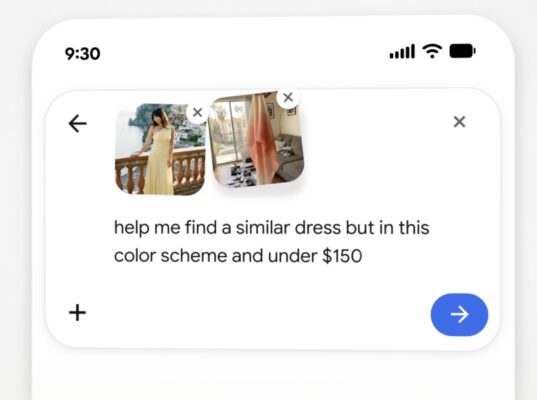
Google’s e-commerce announcements point in the same direction.
The company discussed the Universal Commerce Protocol, Agent Payments Protocol, and Universal Cart. Universal Cart is designed to work across merchants and services, appear across Search and Gemini, and later extend to YouTube and Gmail. It can track price drops, stock status, payment-card perks, compatibility issues, and checkout options.
One example was simple but revealing: a user adds a motherboard to a cart, and the cart notices that it may not match the chosen processor socket.
That is not just shopping search. It is assisted purchasing.
Google does not only want to help users find products. It wants to help them decide, validate, monitor, and buy. If that works, the shopping journey becomes less dependent on a merchant’s website as the primary decision interface.
For retailers, product data quality becomes more important. Accurate feeds, availability, specifications, return policies, compatibility details, reviews, and pricing history may matter more than traditional category-page SEO alone.
The product page still matters. But it may be read first by Google’s agent before it is read by the buyer.
The Advertising Problem Has Not Gone Away
Under the product demos sits a difficult business question: what happens to advertising?
For decades, Search has been one of the most powerful advertising machines ever built. Classic search ads were relatively easy to understand. A user searched for something, sponsored results appeared near organic results, and the user decided whether to click.
AI Search makes that boundary harder to see.
If Google builds the answer, recommends the product, monitors the price, fills the cart, and helps complete the purchase, advertising can no longer be treated as a sponsored link beside organic results. It may become part of the workflow itself.
That creates a trust problem. If an AI shopping agent recommends a laptop, hotel, processor, insurance product, or local service, the user needs to know why. Is the recommendation based on quality, relevance, availability, price, margin, sponsorship, or a mixture of signals?
Advertising can exist inside AI Search. But the labeling has to become clearer, not weaker. A sponsored recommendation from an agent that claims to work on the user’s behalf is more sensitive than a traditional ad on a results page.
The closer Search gets to making decisions, the more carefully Google will have to explain when commercial incentives are involved.
The Legal Fight Over Who Gets to Use the Web
The publisher conflict is not only economic. It is also legal and ethical.
Search engines have always crawled, indexed, ranked, and displayed parts of other people’s content. The trade-off was accepted because publishers received visibility and traffic in return.
AI Search changes the balance. Indexed material can now be transformed into a direct substitute for the original page.
There is a meaningful difference between pointing to a source and absorbing enough of that source to answer the user without a visit. The more complete the AI answer becomes, the more publishers will ask whether the exchange is still fair.
The legal line is not simple. Is an AI-generated answer a modern search snippet, a citation layer, a derivative work, or a replacement product built from someone else’s reporting, testing, writing, and expertise?
Different publishers, platforms, courts, and regulators may answer that differently.
Some publishers may restrict AI crawlers. Others may seek licensing deals. Some may accept lower traffic in exchange for visibility inside AI answers. Others may decide that being summarized without meaningful referral traffic is not worth the cost of producing original work.
Google’s challenge is that AI Search needs high-quality web content to stay useful. But high-quality content is expensive to create. If the best sources decide that AI systems extract too much value and return too little, the web could become more closed, defensive, and fragmented.
A search engine that replaces the web too aggressively may weaken the source material that makes it valuable.
What If the Demo Version Breaks in the Real World?
There is also a simpler question: what if the new Search does not work as smoothly in real life as it does on stage?
Technology keynotes show the cleanest version of a product. The examples are chosen carefully. The data is clean. The assistant understands the request. The generated interface behaves. The recommendation makes sense.
Real users are not demo scripts.
They ask vague questions, mix languages, upload messy files, compare incompatible requirements, rely on outdated listings, and expect the system to know when not to act. In those conditions, AI Search will face familiar generative AI problems: hallucinated details, misunderstood context, stale sources, overconfident summaries, and polished interfaces built on weak logic.
The risk becomes more serious when Search stops being only an answer. A wrong paragraph is inconvenient. A wrong mortgage calculator, product compatibility check, medical summary, or travel booking can cost real money.
This is why the success of AI Search will not depend only on model intelligence. It will depend on verification, source quality, user control, error handling, and clear limits.
The most impressive version of AI Search is not the one that answers everything. It is the one that knows when to slow down, show sources, ask for confirmation, or refuse to decide on incomplete information.
What This Means for Publishers
For publishers, the central risk is obvious: more answers inside Google can mean fewer clicks.
But not all content is equally threatened.
The most vulnerable content types are likely:
- shallow explainers;
- rewritten commodity news;
- basic definitions;
- generic “best X” articles with thin testing;
- simple calculators and lightweight tools;
- listicles that summarize information available elsewhere;
- content built mainly for keyword matching rather than real expertise.
The more defensible content types are likely:
- original reporting;
- expert analysis;
- first-party data;
- technical documentation;
- product testing with real methodology;
- local knowledge;
- professional commentary;
- communities with lived experience;
- content that AI systems need because it cannot be reconstructed from generic sources.
Google says AI Search will still connect users to relevant content. That may happen. But discovery may become more selective. The web may receive fewer casual clicks and more high-intent visits.
Low-value pages may lose visibility. Strong sources may become more important. Publishers that depend on high-volume informational traffic will have to adapt.
What This Means for SEO
SEO is not dead. But SEO as “ranking pages for keywords” is becoming too narrow.
In AI Search, visibility may depend on whether a site can be understood, trusted, cited, summarized, and used by agents.
That means the work changes:
- Entity clarity: make it obvious who you are, what you offer, where you operate, and why you are credible.
- First-party expertise: add examples, observations, workflows, data, testing, or professional judgment that generic summaries cannot easily replace.
- Structured information: make products, services, authors, dates, locations, specifications, and business details easy to parse.
- Content depth: answer real questions, including edge cases and practical steps.
- Source-worthiness: build pages that an AI system would trust enough to cite or use.
- Brand demand: if users ask for your brand by name, you are harder to replace.
The old SEO question was: “How do we get clicks from Google?”
The new question is sharper: “How do we remain useful when Google becomes the interface?”
Google’s Advantage Is Not Just Gemini
Google’s advantage is the combination of AI models, Search index, Maps, Shopping Graph, YouTube, Gmail, Calendar, Chrome, Android, Workspace, payments, and user habit.
A standalone chatbot can answer questions. Google can connect answers to maps, products, videos, documents, calendars, email, payments, local data, and web indexing.
That makes Google’s version of AI Search different from a generic assistant. It is not just a model. It is a model attached to much of the internet’s daily infrastructure.
That is powerful. It is also why the update will be controversial.
The Uncomfortable Question: Who Owns the User Relationship?
The web has always involved tension between platforms and publishers. Google sent traffic to websites. Websites gave Google indexable content. Users moved between them.
AI Search changes that balance.
If Google summarizes the answer, builds the interface, monitors updates, fills the cart, checks compatibility, and helps complete the task, then Google owns more of the user relationship. The source website becomes background infrastructure.
This pattern is familiar:
- social platforms reduced direct publisher traffic;
- marketplaces reduced direct merchant relationships;
- app stores mediated software distribution;
- AI Search may now mediate information, tools, and transactions.
The open web is not disappearing. But its front door is changing.
For many users, the web may feel less like a set of pages and more like a set of capabilities exposed through AI.
What Site Owners Should Do Now
The wrong response is panic. The other wrong response is denial.
Google’s direction is clear enough to justify adaptation, even if rollout details and user behavior continue to change.
For website owners, publishers, and businesses, the priorities are practical:
- publish content that has a real reason to exist;
- add original examples, experience, data, screenshots, workflows, and expert commentary;
- keep pages technically clean and easy to parse;
- use structured data where appropriate;
- strengthen author, company, and service credibility;
- avoid generic AI-written filler;
- build brand recognition outside Google;
- create resources that remain useful even when summarized;
- track citations, impressions, assisted discovery, and branded demand, not only rankings.
The goal is not to “beat AI.” The goal is to become the kind of source AI systems need.
The New Search Is Not Just Search
Google’s I/O 2026 announcement should not be read as one feature launch. It is a platform shift.
Search is becoming conversational, multimodal, personalized, agentic, and capable of building interfaces around the user’s task.
For users, this may feel like convenience. For publishers and businesses, it may feel like losing control of the page.
That is the tension at the center of the new Search. The easier it becomes for users to complete tasks inside Google, the harder it becomes for the rest of the web to prove why it still deserves a visit.
Google Search is not going away. But the version of Search that built the modern web is being replaced by something more ambitious — and much harder for the web to ignore.