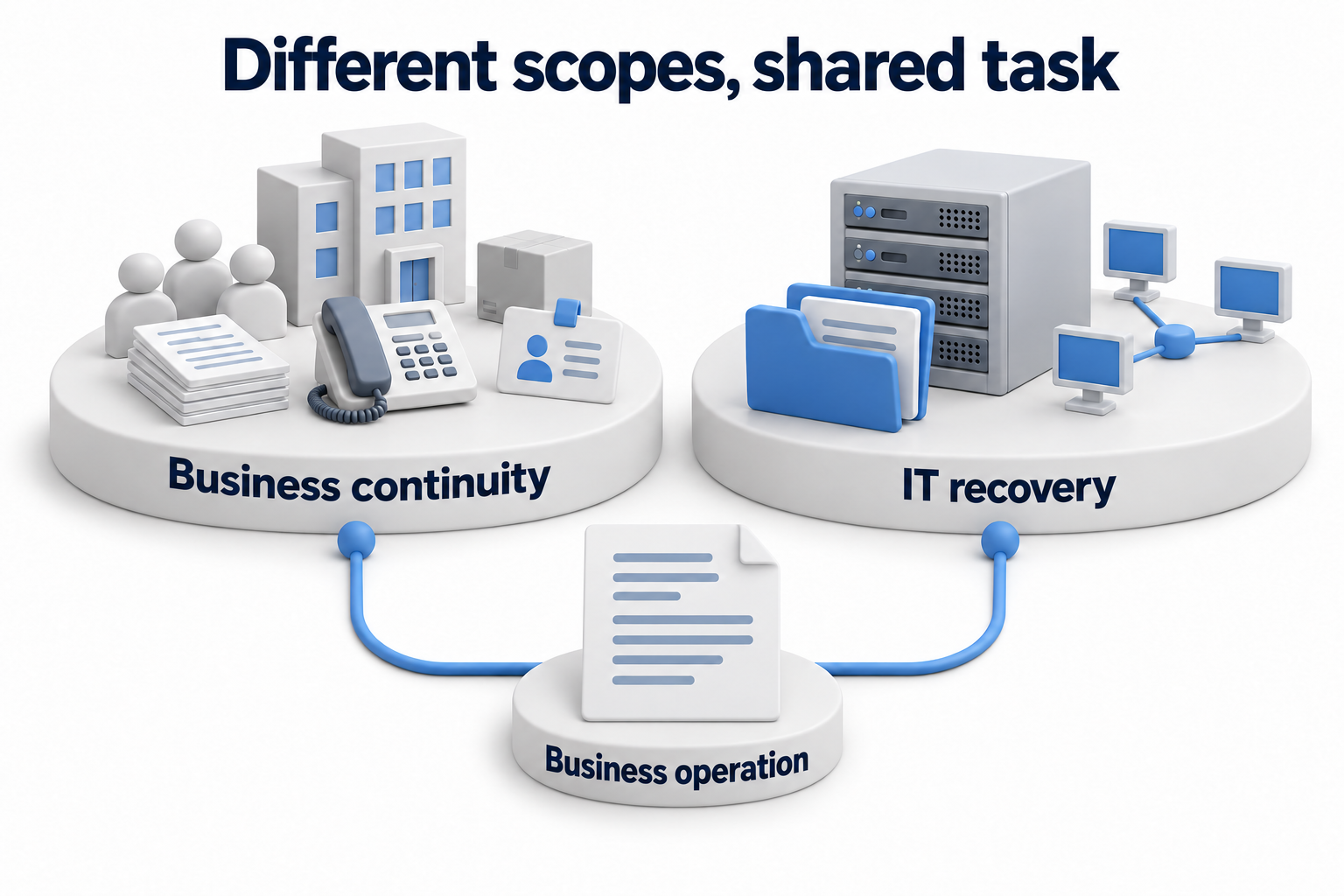
Business continuity asks how to maintain important operations when normal conditions break down. IT disaster recovery asks how to restore the required systems, data, and technical dependencies. These tasks are related but have different scopes. A running server will not help ship an order if staff or a supplier are unavailable. Accepting orders through a temporary process does not remove the need to restore the system and reconcile data.
Choosing between BCP and DRP is therefore usually a matter of document titles rather than responsibility for the result. You can document a continuity plan and a recovery plan separately or as one set. What matters is agreement on priorities, owners, and decision handoffs.
What each task covers
BCP maintains important business processes
A business continuity plan considers people, facilities, equipment, communications, suppliers, and operating procedures. It defines which operations must continue, at what acceptable capacity, and through which temporary methods. These might include an alternative workplace, another communication channel, or an agreed manual process. Verify that the alternative can work before you need it.
Continuity does not promise work without any interruptions or losses. Some operations can run in a limited mode, while others may not support one. Management and the process owner must understand the limits, available resources, and consequences of a temporary solution.
DRP restores the technical ability to work
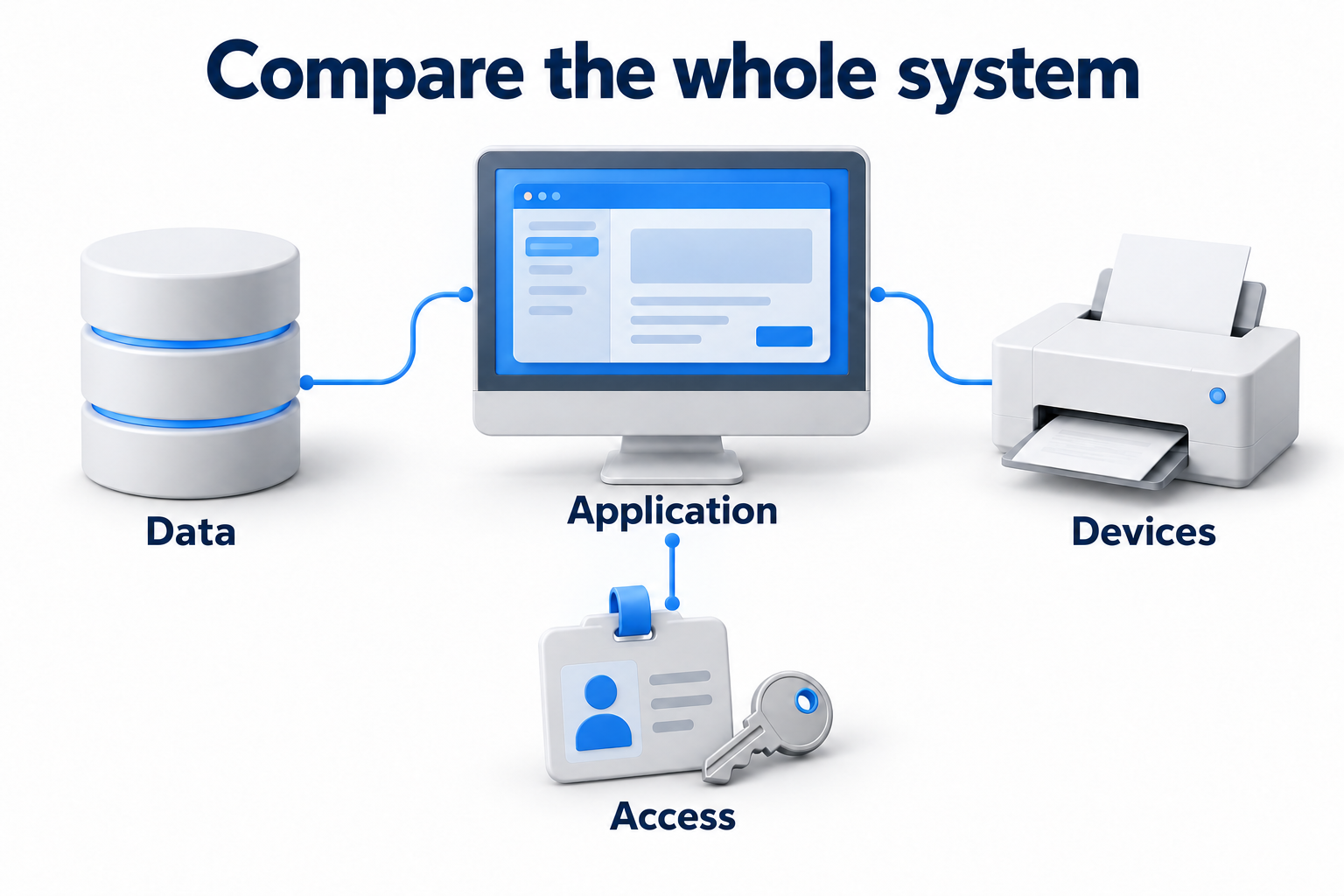
An IT disaster recovery plan describes how to restore or switch the required applications, data, network components, and dependencies. It needs a sequence, access to backups and keys, an available environment, assigned roles, and verification of the result. A backup is one resource, not the entire plan.
Technical recovery must match the business task. Restoring a system that does not support the priority process first can consume resources without the required benefit. Conversely, a critical process may depend on an easily overlooked sign in service, integration, or external participant. Both teams must know these dependencies.
AWS guidance treats IT recovery as part of broader business continuity. Recovery priorities and objectives must account for the business task, risk, and cost. Technical availability alone does not address consequences beyond the application.
Compare scope, owners, and readiness criteria
Different boundaries within one coordinated effort
|
Criterion |
Business continuity |
IT disaster recovery |
|---|---|---|
|
Main question |
How to maintain an important operation when normal conditions break down |
How to restore the technical resources that operation requires |
|
Scope |
People, facilities, suppliers, communications, procedures, and IT system dependencies |
Applications, data, infrastructure, access, and technical dependencies |
|
Responsibility |
Management and process owners working with the relevant departments |
Technical teams working with the owners of business outcomes |
|
Temporary solution |
An agreed limited operating mode or alternative process |
Data restoration, switching, or another planned technical procedure |
|
Starting conditions |
Priorities, acceptable impact, resources, and constraints |
Process requirements, agreed RPO and RTO, and an available environment and procedure |
|
Confirmation of the result |
The important operation runs in the agreed mode |
The technical result and business operation pass verification |
|
Updates |
Processes, people, locations, or suppliers change |
Systems, data, dependencies, or the recovery path change |
Prepare both areas before a disruption. During an interruption, work may proceed in parallel: the business organizes an acceptable temporary operating mode while IT restores its technical foundation. Do not assume that BCP applies only before a disaster or that DR starts only after the crisis has completely ended. Define activation and coordination conditions in the plans.
Where cyber incident response fits
A cyber incident response plan helps detect and assess an event, limit its consequences, and agree on further actions. It connects to recovery and continuity but does not replace them. For example, before restoring an application, establish whether the environment and selected data are safe to use. Starting the technology without that agreement may bring the problem back.
Equipment failure without signs of an attack may call for different procedures. Do not treat a cyber response plan as the universal main document for every business interruption. The current third revision of NIST guidance connects response with broader cyber risk management, including preparation, detection, response, and recovery.
Connect the plans through a shared business task
Agree on priorities and an acceptable operating mode
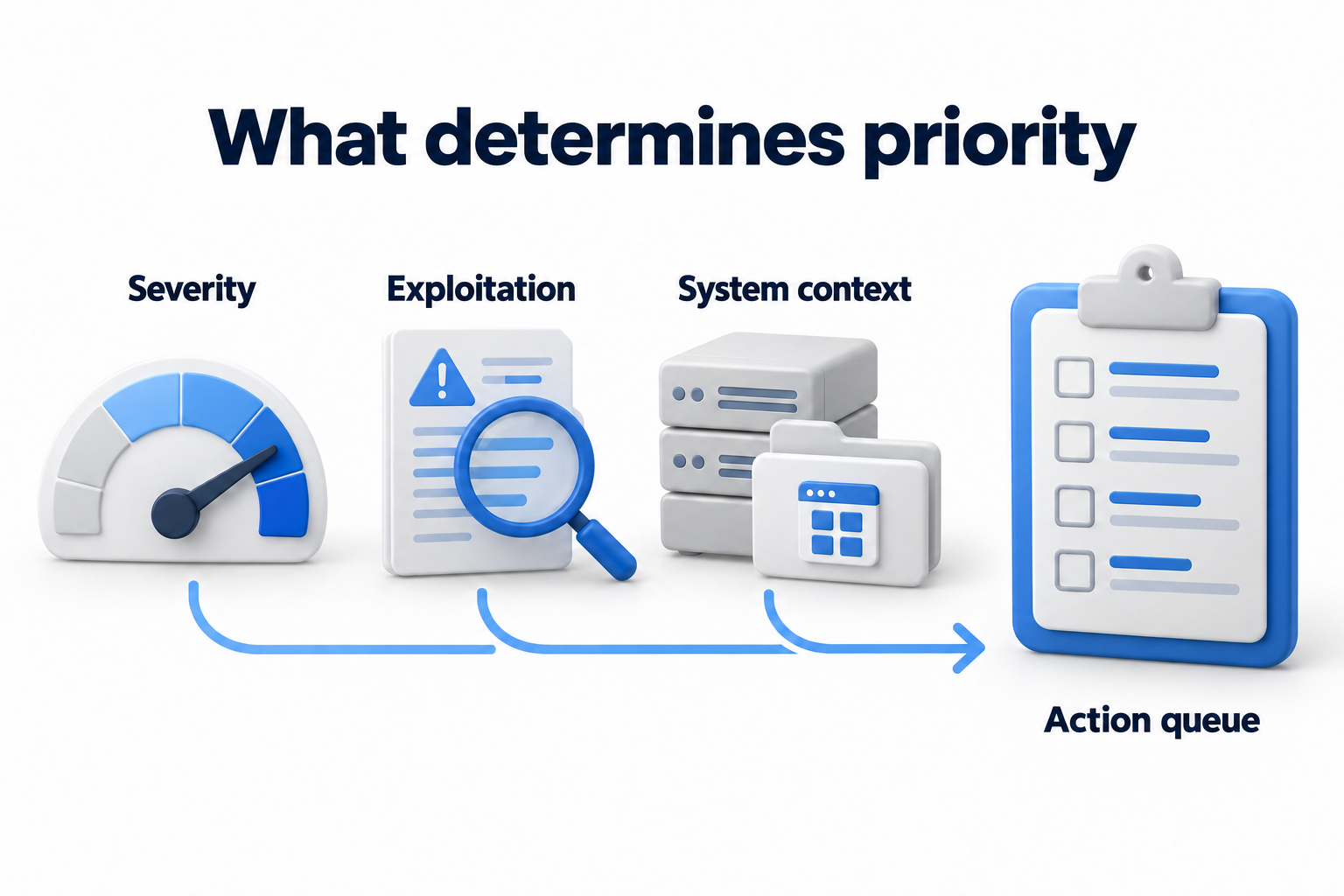
Use the results of the business impact analysis: which operations matter, who an interruption affects, and how consequences change over time. These findings support comparison and coordination of the plans. A complete risk analysis and impact calculation require separate work. Here, verify that both teams use the same priorities.
For each important process, connect its owner, technical dependencies, and acceptable temporary way of working. RTO and RPO objectives must align with these conditions and technical feasibility. This article does not prescribe universal time limits or replace a separate decision on objectives.
Record who activates each set of actions, who approves priority changes, and who receives readiness confirmation. Include backup participants, external teams, and a communication channel for use when normal tools fail. If contacts are available only inside the lost system, coordination may stop along with it.
Work through one hypothetical disruption
Suppose the primary site is unavailable and employees cannot use the order processing system. The following hypothetical scenario checks responsibility boundaries. It is not a ready made procedure for your company. Confirm the feasibility of temporary order intake and the recovery method for your own environment.
A coordinated hypothetical scenario for site unavailability
|
Stage |
Continuity actions |
IT recovery actions |
Coordination point |
|---|---|---|---|
|
Impact assessment |
The process owner identifies affected operations and acceptable working capacity |
The team identifies unavailable components and required dependencies |
Management confirms priorities and activation of the planned actions |
|
Temporary operations |
The team uses an approved alternative channel and records incoming requests |
IT prepares the agreed environment and retrieves usable data |
Participants know the limits, owners, and next status update time |
|
Technical restoration |
The owner prepares a test of the required business operation |
IT restores the system and checks data, access, and connections |
Acceptance depends on function, rather than only a server starting |
|
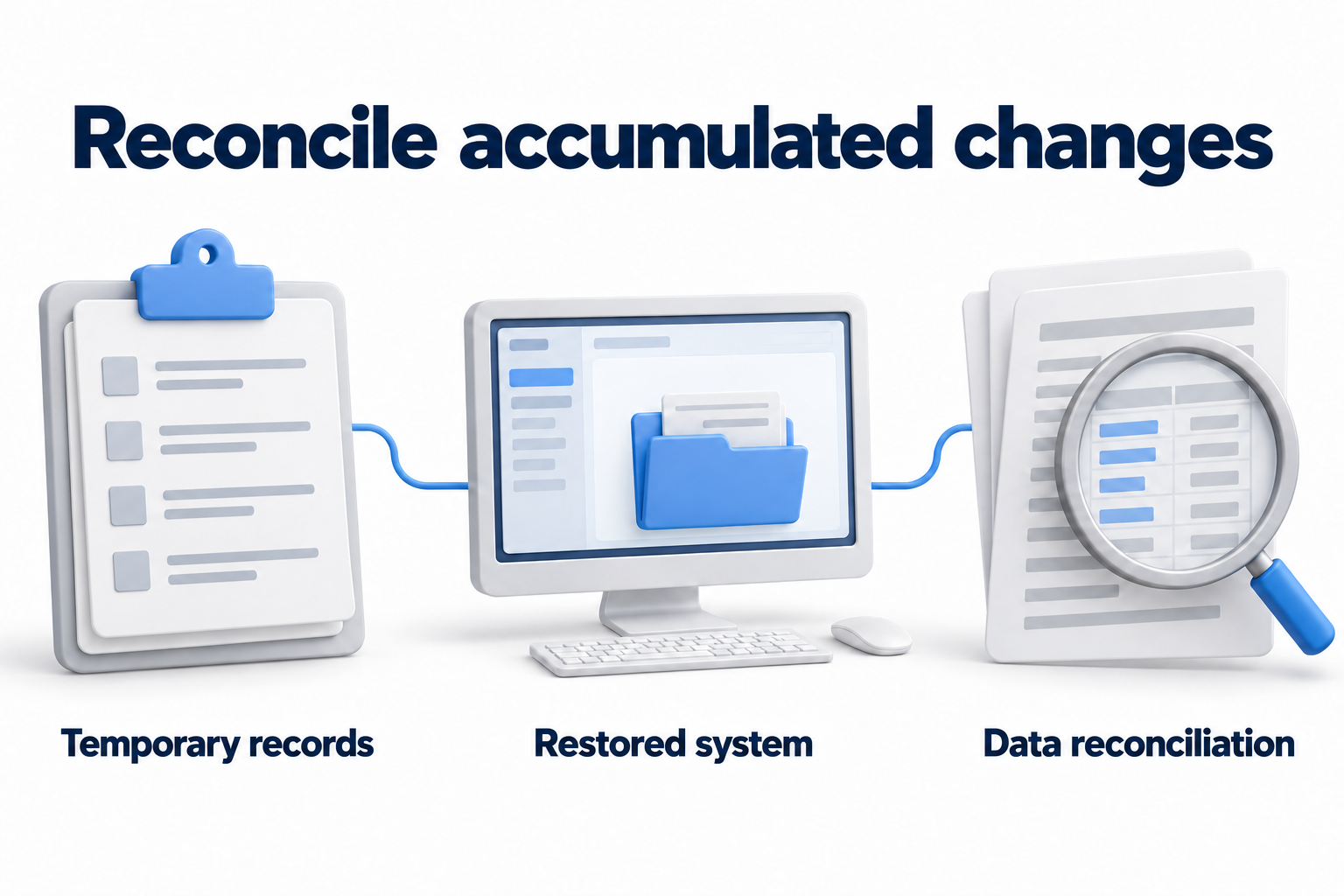
Reconciliation of accumulated records |
The assigned owners compare requests and changes from the temporary period |
IT helps apply the agreed transfer and verification process |
No records are lost, no duplicates appear, and disputed data goes to the owner |
|
Return to normal operations |
The owner confirms the end of temporary operations and informs participants |
The team completes the agreed transition and checks normal protection |
The business result, remaining limits, and further actions are confirmed |
If the same scenario includes signs of an attack, coordinate with those responsible for cyber response as well. Do not restore trust in a system merely because it starts. If temporary manual work is unacceptable, record that too. In that case, you cannot promise it as a universal substitute for IT.
Check gaps at responsibility boundaries
- The business expects an operation to be available, but technical verification stops at starting the infrastructure.
- A temporary way of working exists, but permissions, limits, and an owner remain undefined.
- Process priorities and the system recovery sequence do not match.
- An external service, supplier, communication channel, or backup participant has been overlooked.
- Nobody owns reconciliation of new temporary data with the restored system.
- The team does not know who accepts the result and authorizes the return.
- Contacts, instructions, and evidence exist only in the unavailable environment.
Cloud infrastructure, redundancy, and automation can support recovery, but they do not resolve every issue involving people, supplies, and business decisions. Choose resources for the agreed scenario. Buying a product labeled BCDR does not establish responsibility boundaries or business acceptance criteria.
Test coordination and update decisions
Start a joint review with a selected operation: who decides, how temporary work runs, what IT restores, and who confirms completion. Working through the scenario helps expose unclear points. Test actual recovery separately within the agreed scope. A discussion around a table alone does not prove technical readiness.
After the review, retain the identified gaps, remediation owners, and conditions for retesting. Review the connection between plans after a process, team, system, supplier, or site changes. Frequency depends on risk and applicable requirements, not on a general claim that an annual review is enough for every business.
As a next step, create a short map of one operation: owner, acceptable operating mode, IT dependencies, objectives, temporary data, acceptance, and return. This shows what needs agreement. Develop complete BCP and DRP templates, recovery instructions, and exercise records for the specific conditions.
Need to check whether IT recovery matches business priorities? Contact DKs Enterprises about backup and disaster recovery. Prepare a list of important operations, technical dependencies, and known gaps to discuss the scope of work.