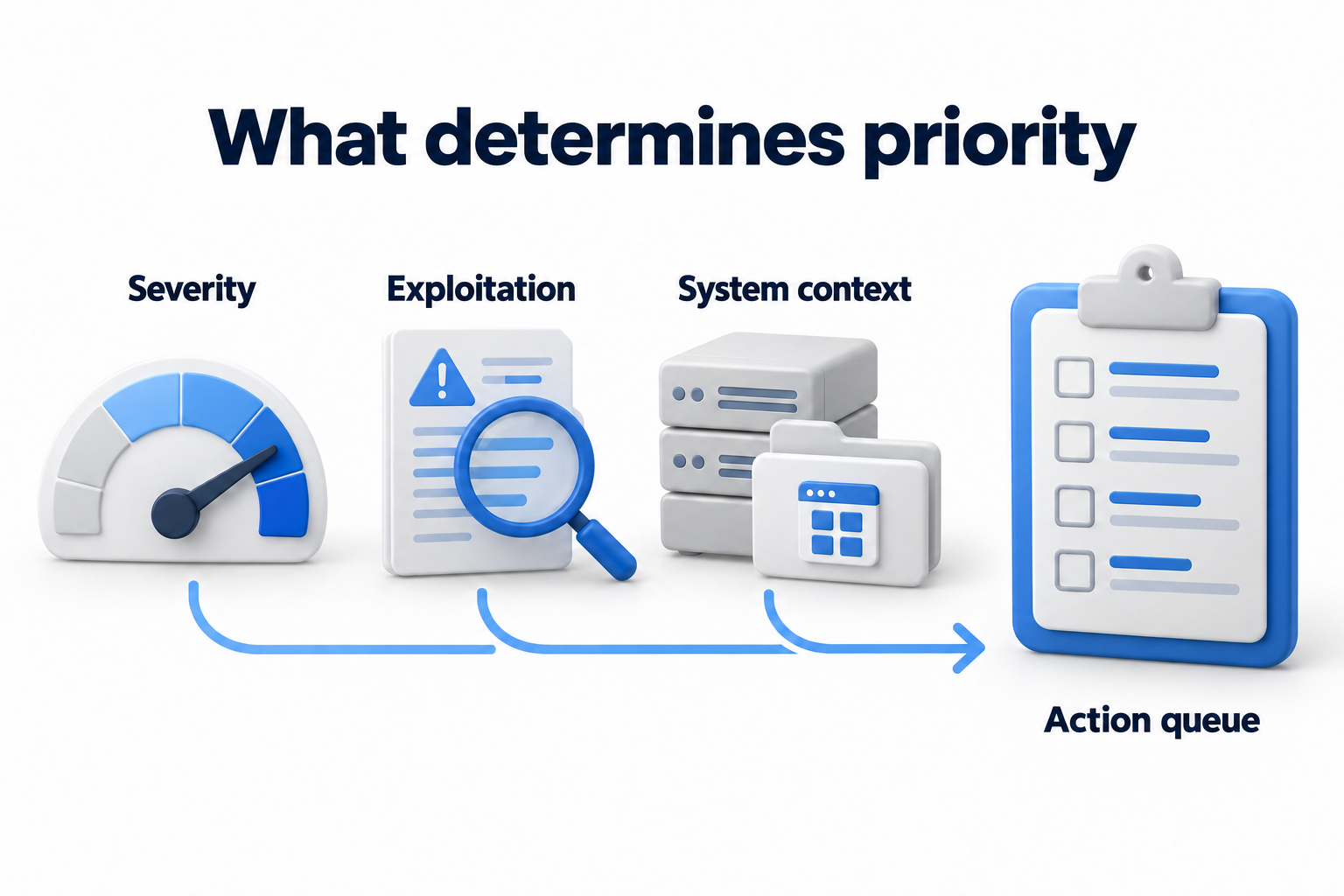
A report may contain hundreds of findings, while the team can verify and fix only some during one work cycle. Sorting by the highest score does not explain what threatens the company now. A useful queue requires you to confirm applicability, assess attack path accessibility, and connect the consequences to the system's role.
Prioritization starts with findings already discovered. It produces a list of decisions: what to fix first, where a temporary control is needed, which information still needs verification, and who owns each action. A general cyber risk assessment has a broader scope, covering processes and scenarios. This article focuses on the queue of technical problems.
Prepare findings you can trust
Consolidate assessment results around one asset identifier and one problem in a specific component. Keep the source, discovery date, component version, and evidence. The same CVE on different servers may have different priorities. Multiple reports about one instance should not become separate independent tasks. A shared root cause, such as a container base image, may still bring work for many instances together.
Confirm whether the product, version, and configuration are actually affected. Use the vendor bulletin and verified system information. A missing CVE number does not make a configuration error safe. An absent component or incompatible platform may establish that a finding does not apply. Internal deployment or infrequent use alone does not. Assign a disputed finding a verification owner and deadline.
Record whether the vulnerable condition is reachable separately. For an application, establish whether the affected code runs and with which data or permissions. For a server, establish who can connect to the relevant service. Code reachability and internet exposure describe different conditions and do not replace each other. If a network rule blocks the current path, check internal paths and the possibility of changing that rule. A claim that something is unused needs evidence and a review date.
Separate severity, exploitation, and prediction
|
Signal |
What it shows |
What it does not establish |
|---|---|---|
|
CVSS |
Technical characteristics and severity. Keep the version, score, and vector where available. |
A base score does not show the full urgency for your organization. Do not combine scores from different versions without considering their differences. |
|
KEV |
The CISA catalog contains vulnerabilities with confirmed exploitation in real attacks. |
An entry does not prove that your instance is affected or already compromised. Absence from the catalog does not prove safety. |
|
EPSS |
An estimate updated daily of the likelihood that exploitation of a published CVE will be observed in real attacks within the next 30 days. |
It is not the probability of your particular company being breached or a measure of damage. A percentile shows a rating's position among other ratings, not a probability. |
|
SSVC |
A decision tree connects facts and the selected stakeholder's context to an action on a vulnerability. |
It is not another severity score or a universal set of deadlines for every organization. |
You can refine CVSS using threat and environmental information under the selected version's rules. In version 4.0, Supplemental metrics provide context but do not change the final score. Compare entries with a clear score source, and make queue decisions together with environment data.
Do not multiply CVSS by EPSS to create a supposedly precise risk value. The scales describe different quantities. A low EPSS does not override exploitation already confirmed in KEV. A public attack demonstration, confirmed use in real attacks, and signs of an attack inside the company also differ. The last of these requires incident response alongside vulnerability remediation.
If you use SSVC, select a tree appropriate to your role and retain its version, answers, and reasoning. Discuss technical impact and operational consequences with the system owner. An explainable path to a decision is useful. Copying someone else's urgency labels without connecting them to internal actions is not.
Clarify consequences and the actual limits of protection
- Asset purpose and owner: which operations and data depend on the system, and whether a working alternative exists.
- Accessibility: internet, internal network, partners, remote administration, and required credentials.
- Possible attack outcome: reading data, changing records, stopping a service, expanding privileges, or reaching other systems.
- Existing controls: connection restrictions, disabling a feature, isolation, filtering, and detection. Record coverage and evidence of effectiveness against the relevant path.
- Remediation dependencies: vendor, library, base image, application compatibility, restart requirements, and an available work window.
Do not lower priority merely because a device has protective software installed or runs on an internal network. A control must block the specific exploitation condition and work on the relevant asset. Detecting an attack and preventing its execution have different effects. Without enough evidence, record the uncertainty and a short verification task instead of an unsupported exclusion.
Build a working priority matrix
The following rules are examples for internal discussion. They are not an industry standard or a promised remediation time. The organization agrees on its own levels, deadlines, and authority. An actual entry needs a calendar date, one task owner, and an explanation of the decision.
|
Finding conditions |
Decision and reasoning |
Owner and deadline |
Closure evidence |
|---|---|---|---|
|
There are signs of exploitation in your environment. |
Escalate immediately under the response plan. In parallel, identify a safe way to limit impact. A routine update installation is insufficient. |
Assigned incident coordinator and system owner; agree on actions and timing during the response. |
Evidence has been retained, agreed response actions completed, and remediation of the applicable problem verified. |
|
Exploitation is confirmed in KEV, and the affected service is externally accessible and important to operations. |
Prioritize verification and accelerated remediation or temporarily block the path. Reason: applicability, accessibility, and consequences are confirmed. |
Change implementer; an authorized owner sets the date based on risk and a safe work window. |
The fixed version or configuration, previous exploitation condition, and service operation have been checked. |
|
Technical severity is high, but the affected function is disabled and the restriction is verified. |
Schedule remediation and monitor the restriction. The high score remains, but current conditions inform the decision. |
Asset owner; a remediation date and a separate date to verify the restriction. |
The function's state, absence of a bypass, and result of the planned fix have been confirmed. |
|
A component exists in a shared library or an image used by many systems. |
Combine work on the root cause while retaining the list of affected instances and their different exposure conditions. |
Library or image owner; an agreed deployment deadline across dependent systems. |
The source image is not the only thing updated: new instances are deployed, and old ones are checked or retired. |
|
Applicability or accessibility remains unknown. |
Verify the information first. Do not close the finding or present an assumption as low risk. |
Assigned reviewer; a specific response date and an escalation process for delays. |
Evidence confirms applicability or supports dismissing the finding, with a date and author. |
In the queue itself, keep the finding ID, asset ID, source, CVE where available, technical severity, exploitation evidence, and its date. Add accessibility, criticality, verified controls, selected priority, reason, action, implementer, deadline, status, and an evidence link. Connect the entry to the change ticket so updating the queue does not require separate manual correspondence.
When several tasks share a priority, compare the scale of impact, dependencies, and opportunities to remove a shared cause. Effort helps schedule work, but it does not turn a complex dangerous problem into a safe one. Fixing several minor findings quickly should not displace a critical task merely to improve closure counts.
Assign a safe action even without an available patch
A missing update does not mean the problem should leave the top of the queue. Check vendor recommendations: can you restrict access, disable the affected function, isolate the system, or replace an unsupported component? Agree on each restriction with the process owner and verify its effect. If no acceptable method exists, an authorized manager must decide whether the service can remain in use.
For a deferred task, record the reason, residual risk, approver, temporary control, exception expiration, and review date. Risk acceptance is not a false positive. An unsupported legacy system needs a replacement or retirement decision, rather than endless extensions of a later status.
Before a change, check compatibility and prepare the required backup and a way to restore settings. Start with an agreed test environment or limited group, test the application, and only then expand deployment. An urgent change can accelerate the agreed process, but still needs an owner and stop and rollback conditions. Automation must follow approved rules rather than change all critical systems without control.
Set internal deadlines using facts, consequences, and applicable obligations. CISA remediation deadlines apply to the organizations specified in the relevant directives. They do not automatically become law for a private company. Do not assign every finding with the same score an identical deadline without checking conditions and contract requirements. Escalate delays to the risk owner instead of quietly moving the date.
Verify fixes and review the queue
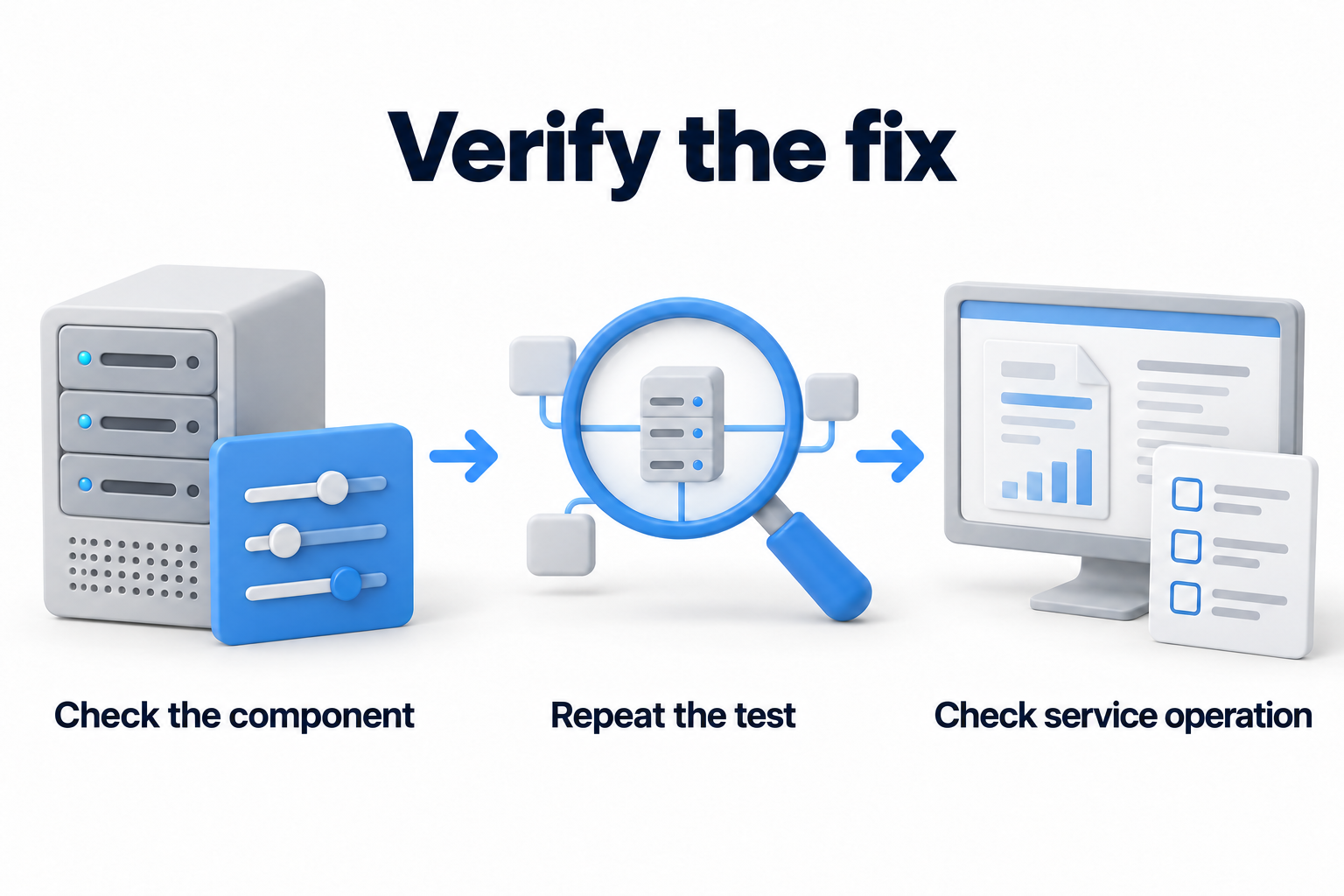
Installing an update does not yet prove closure. Check the component's actual state on the relevant instances, safely repeat the previous condition check, and confirm that the business process still works. Look for old images, powered off devices, or a second service node that may remain. Attach the details and result to the entry.
Update priority when exploitation evidence, EPSS, service accessibility, asset role, or a restriction's effectiveness changes. Retain the date and reason for a revised decision. Schedule regular queue reconciliation and a separate response to important new signals. If an assessment source no longer covers an asset, that is a monitoring gap, not proof of remediation.
Show owners more than the number of closed findings. Useful measures include overdue tasks with high priority, time to verified containment and remediation, the share of assets with a current assessment, recurring problems, and active exceptions. Compare measures with the same scope. Removing an asset from a report or changing scanners can change the numbers without reducing actual risk.
If priorities are agreed but technical resources are insufficient to implement and verify fixes, discuss the work with DKs through the Security Vulnerability Remediation page. Provide verified findings, system owners, and change constraints.