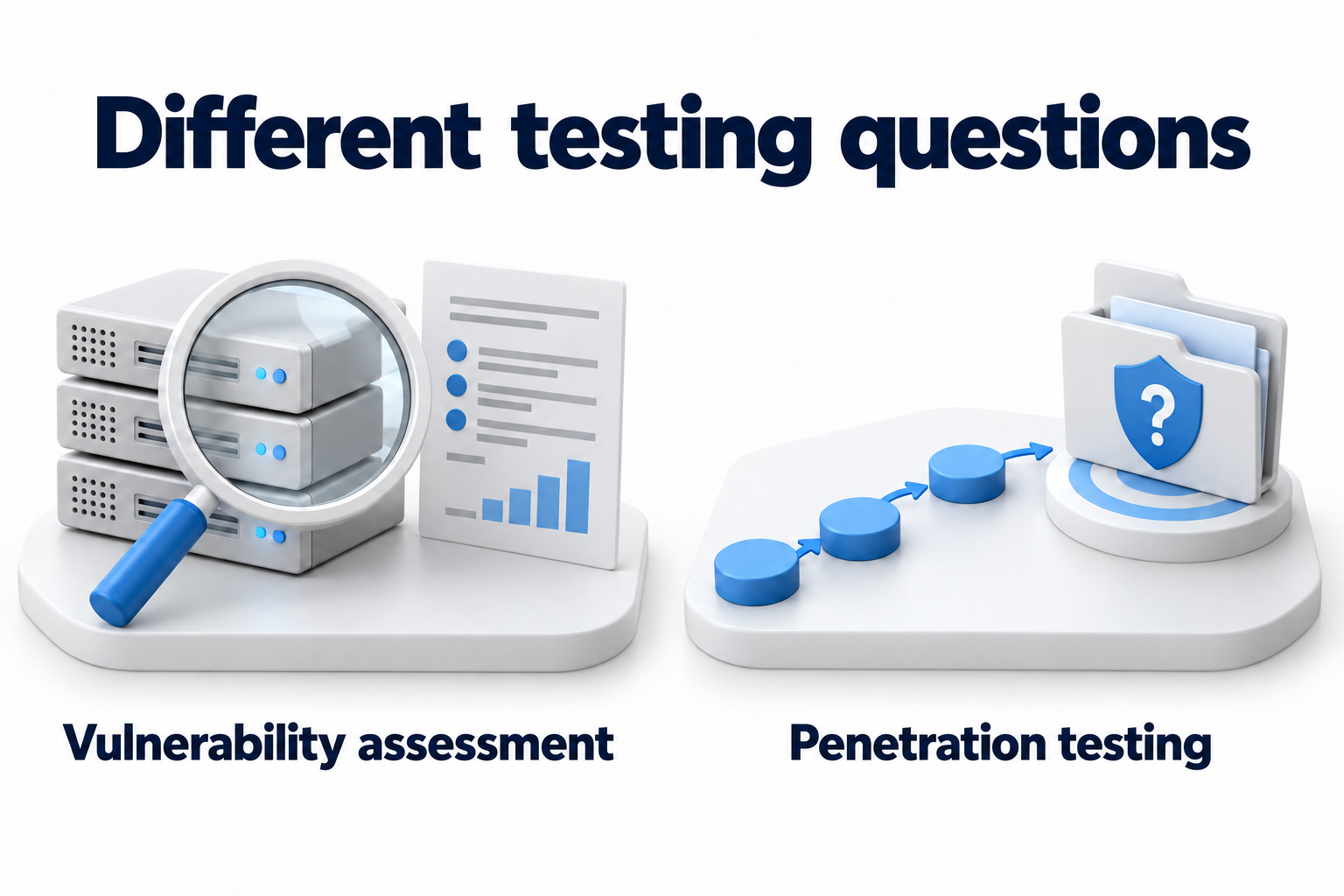
A vulnerability assessment helps find and analyze weaknesses across an agreed set of systems. A penetration test checks whether weaknesses can be used to achieve a specific goal, such as access to protected data. Both approaches are useful, but they answer different questions. To choose a test, first define the decision its results must support.
If you need a list of issues for regular remediation, start with a vulnerability assessment. If you need to check a particular attack path or an important application's resilience in a defined scenario, consider penetration testing. No report guarantees protection against every attack. Every test has limits on time, scope, access, and permitted actions.
Understand what each approach checks
Vulnerability assessment: from discovery to verified findings
An assessment may include automated scanning, configuration checks, and manual analysis of results. A scanner compares discovered components and their state with known signs of problems. A specialist confirms whether findings apply, removes duplicates and false positives, assesses consequences, and proposes actions. A scanner export is therefore not equivalent to a completed assessment.
An external test shows the externally accessible part of a system. An internal test examines conditions within an agreed network or environment. Testing with credentials may reveal more about versions and settings than external observation, but its coverage depends on the permissions granted and successful sign in. Scanner authentication failure does not prove the absence of vulnerabilities. Choose these options for the task, rather than assuming one method is best.
Penetration testing: checking an agreed scenario
Testers investigate the authorized target and try to confirm a path to a meaningful result. They may combine several weaknesses that appear less serious individually. The work combines tools and manual analysis. Exploitation, privilege escalation, data access, and testing the response of protective controls are permitted only within agreed boundaries.
A test does not have to cover every device and every possible attack. Sometimes safe evidence of possible access, without copying real data, is enough to confirm a risk. The rules of engagement define the depth. Failure to reproduce an attack within the allotted time does not mean that the path is impossible.
Compare the methods by working conditions
|
Criterion |
Vulnerability assessment |
Penetration testing |
|---|---|---|
|
Main question |
Which weaknesses were found, what do they affect, and what needs fixing? |
Can specific weaknesses or their combination achieve the agreed goal? |
|
Scope |
An agreed set of assets, services, and access methods. Broad, repeatable coverage is often needed. |
Agreed applications, environments, or scenarios. Scope may be narrow or broad according to the task. |
|
Method |
Scanning, configuration review, and analysis of whether findings apply. |
Scenario investigation, manual testing, and authorized confirmation of an attack's feasibility. |
|
Authorization |
Owner approval, boundaries, methods, and starting conditions are required. |
Written rules with explicitly permitted and prohibited actions are required. |
|
Operational risk |
Active testing can also create load or disrupt a sensitive service. |
Exploitation attempts increase the risk of impact; stop and recovery conditions are needed. |
|
Result |
A verified findings list, evidence, applicability, recommendations, and scope limitations. |
Confirmed paths, achieved results, limitations, evidence, and recommendations. |
|
Frequency |
Repeat according to risk, changes, and applicable requirements. Automation helps but does not replace analysis. |
Perform when a scenario needs testing, after significant changes, and according to applicable requirements. |
|
Main limitation |
Not every scanner finding is real; unknown errors and complex logic may remain undetected. |
Time, team knowledge, and permitted actions limit depth. Exhaustive results are not guaranteed. |
Company size alone does not determine the method. A small developer may need a deep test of a client application, while a large organization needs regular assessments across many devices. Compare proposals with the same scope and expected result. Cost depends on complexity, access, manual effort, reporting, and retesting. A universal price or duration would not help.
Choose the test for the task
|
Situation |
Practical choice |
Condition for a useful result |
|---|---|---|
|
No reliable list of weaknesses exists for managed systems |
A vulnerability assessment with verified coverage and applicability. |
Asset owners and people able to analyze and fix findings are available. |
|
Access to other users' data needs testing before an important application launches |
Targeted penetration testing with authorized scenarios and accounts for different roles. |
The environment, safe data, and testing rules are prepared; developers are ready to fix problems. |
|
Protective tools exist, but their ability to block a particular attack path is unclear |
Test the agreed scenario. If needed, separately test detection and response. |
Response assessment is included in the assignment, with agreed roles and notification methods. |
|
A long list of known problems exists without assigned actions |
First analyze, prioritize, and remediate verified findings. |
Commission a new test to resolve a specific uncertainty, rather than replace work on known issues. |
|
Infrastructure has changed or an important problem has been fixed |
Reassess the affected scope or perform a targeted test of the previous attack path. |
The change being verified and any related dependencies the work may have affected are clear. |
After an incident, first perform the agreed response, preserve evidence, and limit impact. A scheduled penetration test does not replace an investigation. Agree on testing fixes and remaining attack paths after stabilization so it does not interfere with recovery and analysis.
A compliance assessment, a program for external researchers to find bugs, and a security team exercise have their own goals and rules. They are not automatically synonyms for penetration testing. If the customer expects detection or employee response testing, include it separately in the assignment instead of treating it as a mandatory part of every test.
Prepare the scope and safe working conditions
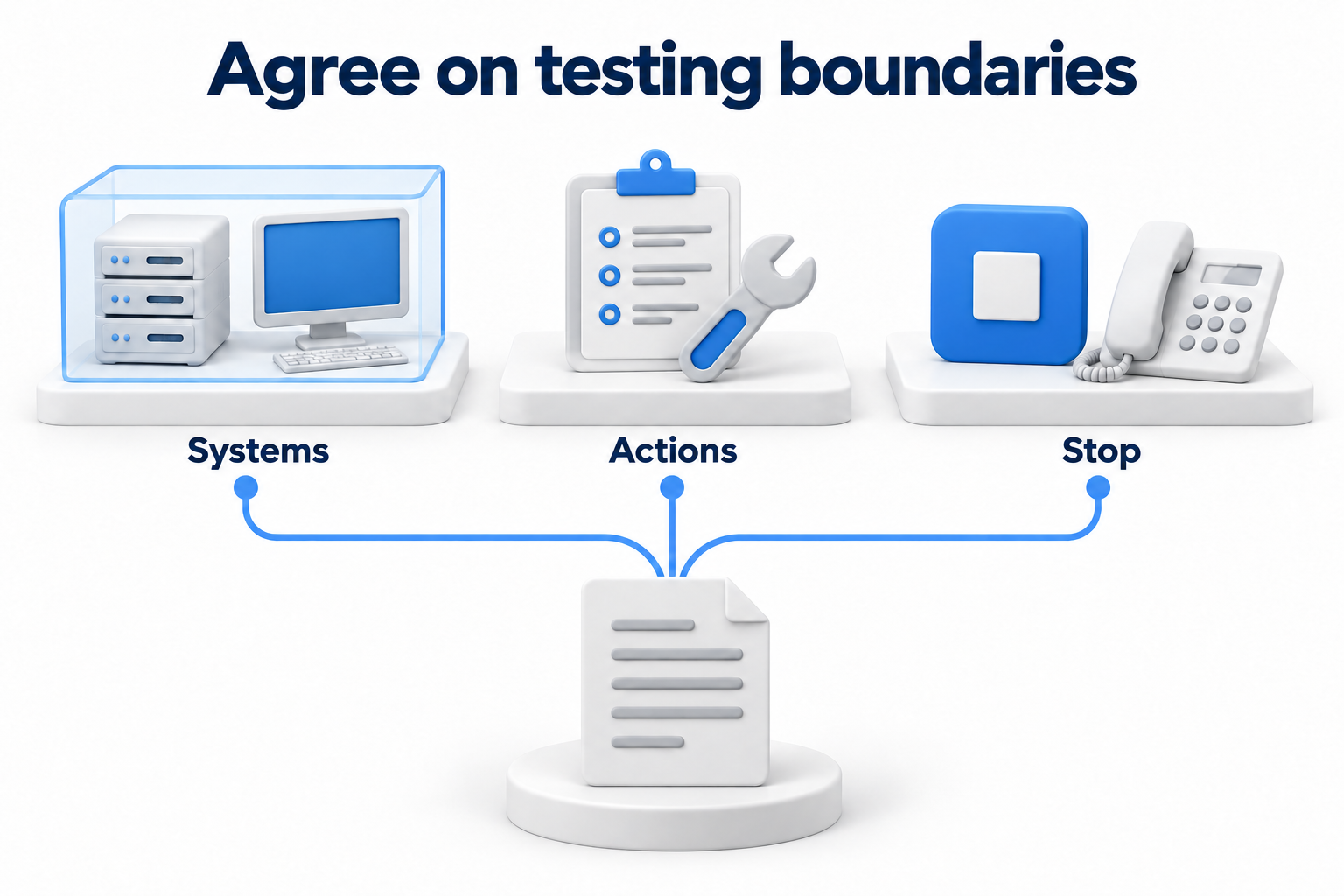
Obtain authorization from the empowered system owner. For external services and cloud infrastructure, check provider terms. A company's contract with a tester does not authorize testing someone else's resources. Record permitted addresses, applications, accounts, and environments. Specify exclusions, prohibited impacts, and the process for approving scope changes separately.
- State the goal, dates, work window, starting point, and information the team receives in advance.
- Define whether active checks, exploitation attempts, staff testing, and data access are permitted. The absence of a prohibition does not replace permission.
- Assign operational and emergency contacts, immediate stop conditions, and a resumption process.
- Agree on load limits, recovery measures, and backup preparation where testing could harm operations. Discuss a safe testing method for sensitive systems first.
- Describe protection of results, evidence retention, report delivery, and removal of temporary access and artifacts. Passwords and sensitive data must not appear in publicly accessible reports.
The amount of starting information also affects the result. Testing without internal design information models limited knowledge, but discovery consumes some of the time. Providing architecture and access allows deeper testing of the selected conditions. This is not a quality scale. The approach must match the customer's question. Record supplied information and active constraints so results can be compared.
Agree on the report and follow findings through remediation verification
What results should contain
- A short conclusion for the process owner: what was tested, what was found, and which decision is required.
- Actual scope, dates, methods, access, exclusions, and unsuccessful checks. Untested assets must remain visible in the report.
- For each finding: affected asset, triggering conditions, evidence, confidence level, and possible consequences.
- Recommendations with a clear expected effect. Penetration testing also needs a description of the confirmed path and the result achieved within permitted boundaries.
- The process for notifying critical findings during testing, retest criteria, and rules for delivering the detailed technical report.
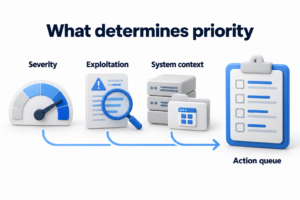
Technical severity helps compare findings, but it does not replace assessing their importance to a particular system. Remediation priority also considers attack path accessibility, confirmed exploitation, the asset's role, and existing constraints. Maintain the detailed priority matrix separately. The testing assignment must provide enough evidence to fill it in.
Who owns the work after report delivery
Assign an owner to each confirmed problem and an implementer to its fix. Agree on timing, dependencies, and a safe change window. If a finding is disputed, request an applicability check and keep the reasoning. Dismiss false positives through evidence, not because remediation is inconvenient. Document any inability to change immediately as a temporary decision with an owner and review date.
After the change, test the relevant component and the conditions that previously triggered the problem. For a confirmed attack chain, verify that the path to the goal has been removed, rather than only one visible finding. Test application operation separately. A retest can confirm a specific fix, but it does not make the whole environment permanently secure. Return the results to the regular vulnerability management process.
Confirm testing frequency and required formats against applicable contracts, requirements, and their scope. Do not infer the same obligation for every company merely from an industry or standard name. Request the exact requirement and acceptance criterion before choosing a provider. Vulnerability assessment and penetration testing can complement each other, but one does not automatically satisfy a requirement for the other.
If you first need a verified picture of technical weaknesses, discuss the task with DKs through the Security Assessment page. Agree on scope, starting information, and expected assessment results.