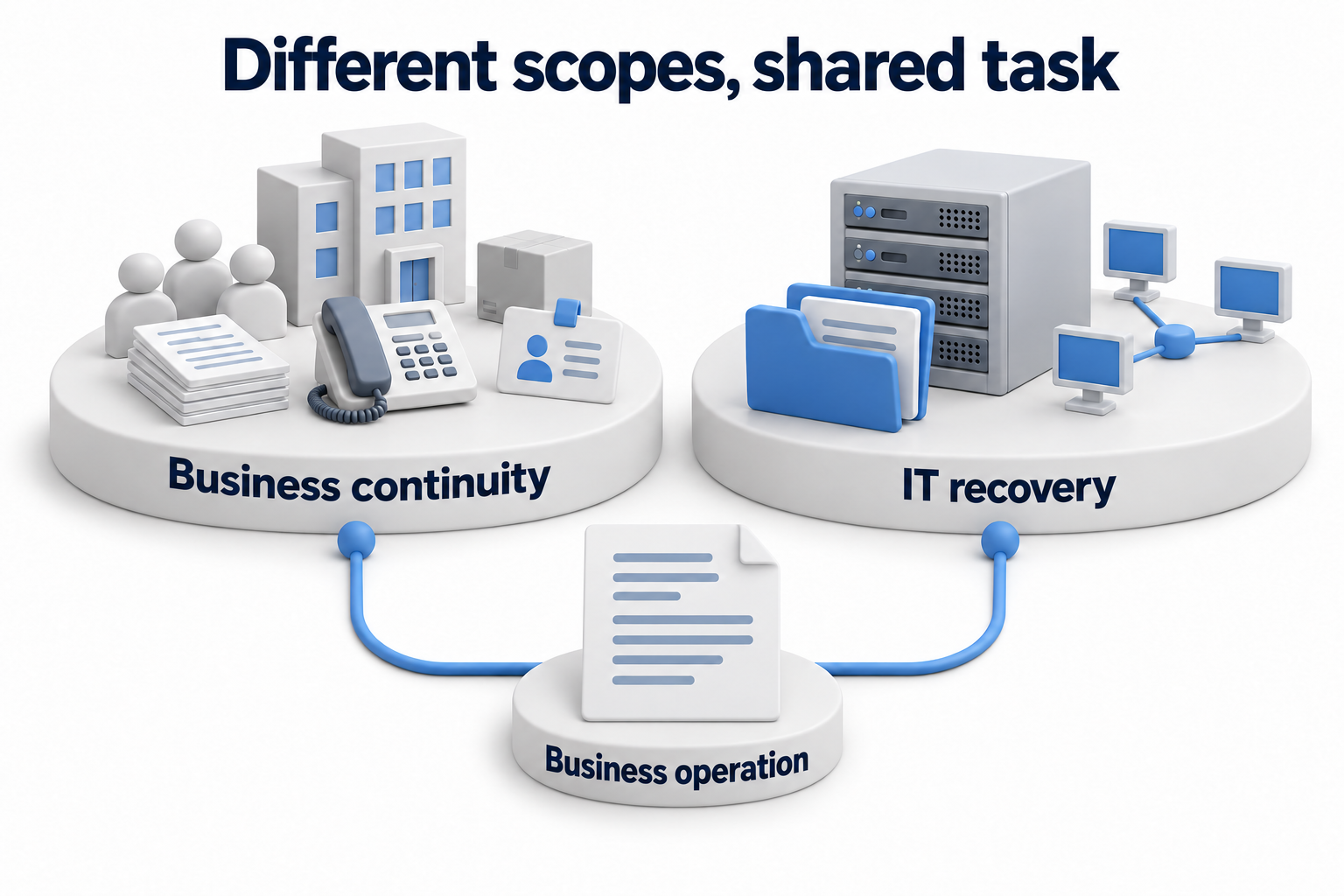
A backup may exist while the business still cannot resume work. Its data may be too old. Or recovery may finish later than employees and customers can wait. To manage these limits separately, the company sets two objectives: RPO for data loss and RTO for recovery time.
These measures apply to a specific service or business system. Define them from the consequences of a disruption, then compare them with IT capabilities. A successful backup status or a provider's promise does not by itself confirm that the objectives can be met.
Separate data loss from downtime
What RPO means
Recovery Point Objective, or RPO, expresses acceptable loss of recent data as a time interval. The question for the process owner is: which recent changes could the company lose or recreate from other sources without unacceptable consequences?
RPO does not measure file size. The same interval could represent a few changed documents or many orders. Alongside the time, record which information changes, how often and whether missing records can be reliably recreated.
What RTO means
Recovery Time Objective, or RTO, sets the target time to return a system or service to an agreed operating state after a disruption. Define that state in advance. A running virtual machine does not yet mean an employee can log in, open data and perform the required operation.
AWS distinguishes these objectives as follows: RTO limits the acceptable delay in restoring a service, while RPO defines the acceptable interval of data loss before the disruption. The organization sets both objectives for its own processes.
An objective and a measured result serve different purposes
|
Measure |
Question it answers |
What to verify |
|---|---|---|
|
RPO |
How recent must the preserved data be? |
The latest usable and consistent data point |
|
RTO |
When must the service be available again for the agreed work? |
Time until user testing and acceptance |
|
Actual result |
What was achieved in a specific test or incident? |
Timestamps, data preservation and completed work actions |
Do not confuse the objective with the result
Set the objective before a disruption. Measure actual recovery afterward or during a test. If the team restores the service more slowly than the target allows, address the gap or refer it to the business owner for a decision. Do not retroactively rename the actual duration as the new RTO and call the test successful.
A reported mean recovery time, sometimes called MTTR, also does not replace RTO. An average describes a set of observations. It can hide individual long disruptions. Assessing the objective requires results from relevant scenarios and reasons for deviations.
Define clear measurement boundaries
Identify the data point and the service return time
To assess data loss, compare the disruption time with the latest point from which the required state was actually restored. Use the data and transactions at that point, not just the backup job's start time. A failed job, replication lag or an inconsistent copy may increase the actual gap. Consider a hypothetical example: the disruption occurs at 12:00, the latest usable point contains data as of 11:45 and the work operation is confirmed at 13:00. The data gap is 15 minutes and downtime is one hour. Compare each value with its approved objective. They are different intervals even when measured in the same units.
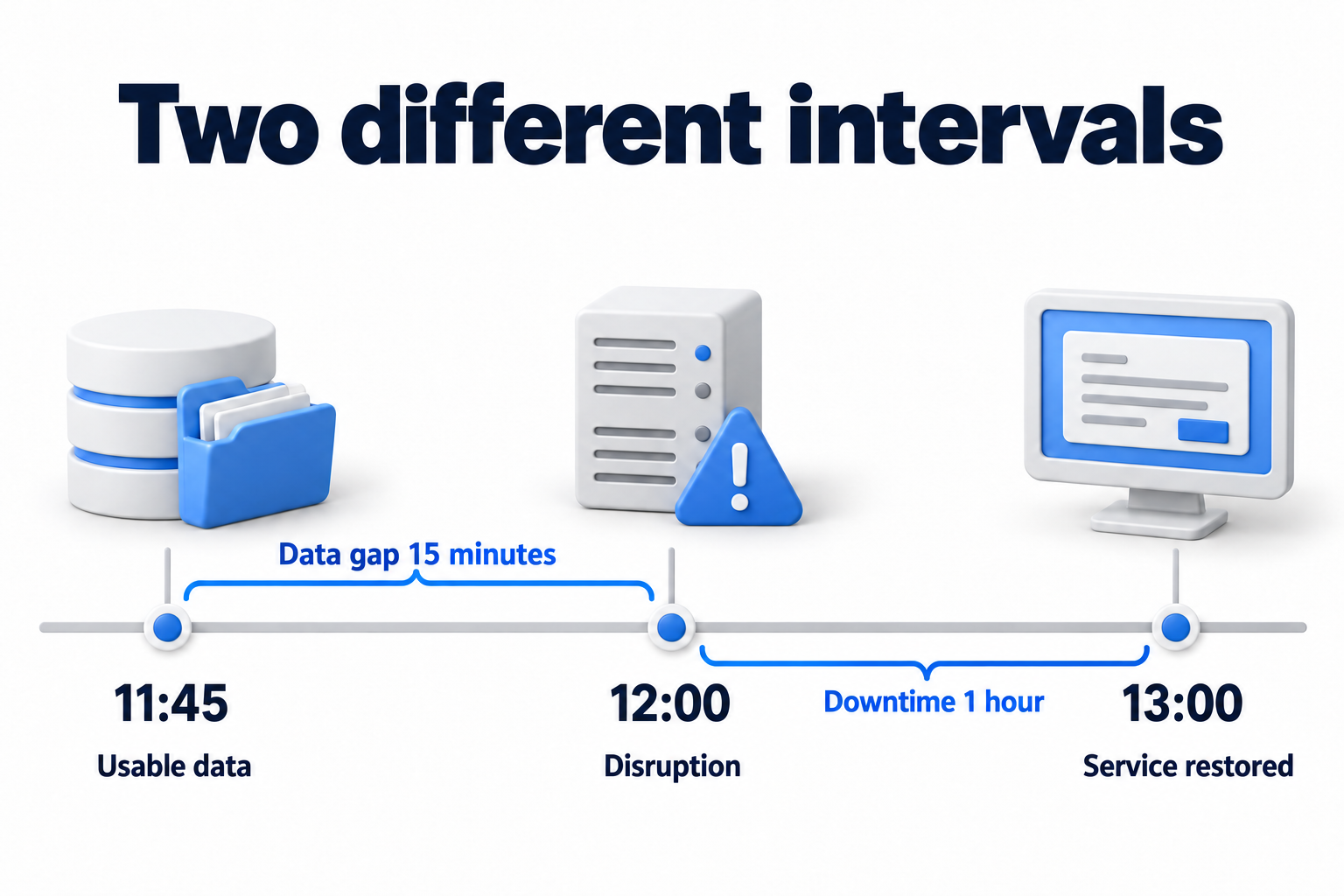
To assess downtime, count from the agreed disruption event until service availability is confirmed. Include detection, the recovery decision, access and resource preparation, data transfer, dependency startup and result verification. Record any excluded time explicitly, or teams will compare different quantities.
With hidden data corruption, the latest usable point may be older than the newest backup. The age of the latest job therefore does not always show the actual loss. During testing, confirm that the chosen version contains usable data rather than a saved error.
Define the minimum working outcome
Record a specific action that will confirm recovery. For email, it may be logging in and sending a message. For a file service, the required folders and permissions matter. A business database needs data checks and an application operation, not just server availability. Agree on whether temporarily limited functionality is acceptable.
Restoring IT does not always restore the entire process immediately. After startup, the team may need to reconcile records, handle accumulated requests and contact business partners. Allow time for these actions in the broader continuity plan. Do not substitute technical startup time for the acceptable downtime of the business process.
Agree on objectives for each important system
Start with business consequences
The process owner explains what will stop during a failure, who will be affected and how consequences change over time. A payment service, internal archive and document preparation system will have different answers. Importance depends on when the application is used, obligations and available workarounds, not just its name.
- Which operations cannot be performed without this system?
- Which data will appear or change between usable recovery points?
- Can missing changes be recreated from a verified source, and how much work will that require?
- Is there an agreed temporary process, and when will it stop coping?
- Which internal or external obligations affect acceptable loss and timing?
Do not assign objectives from someone else's industry table. The same system can support different work in different companies. Check applicable requirements separately. A claim that a particular law sets the same RPO and RTO for every organization in an industry does not replace this work.
Complete the objectives matrix
Copy the form and fill the square brackets with owners' decisions. Include not only end applications, but also required authentication services, networks and ways to access backups.
Objectives matrix without preset deadlines
|
System |
Working outcome |
Acceptable data loss |
Acceptable downtime |
Decision owner |
Feasibility check |
|---|---|---|---|---|---|
|
Corporate email |
[Login and agreed email operations] |
[Interval and correspondence covered] |
[Target time] |
[Process owner] |
[Usable point, login and email exchange test] |
|
Work files |
[Required folders with correct permissions] |
[Change interval and reconciliation method] |
[Target time] |
[Data owner] |
[File version, access and work action] |
|
Core application |
[Agreed operation using verified data] |
[Transaction interval] |
[Target time] |
[Application owner] |
[Dependency sequence and operation acceptance] |
Retain the approval date, failure scenario and technical test owners. If several applications share one category, they need compatible downtime consequences and dependencies. Labels such as critical tier do not define acceptable minutes by themselves.
Check dependencies, costs and limits
Recover the service together with its environment
An application may depend on a user directory, DNS, the network, a database, certificates, keys and external integrations. The loss of any required link changes the result. Check startup order and the team's access to recovery tools, especially if normal corporate authentication is unavailable.
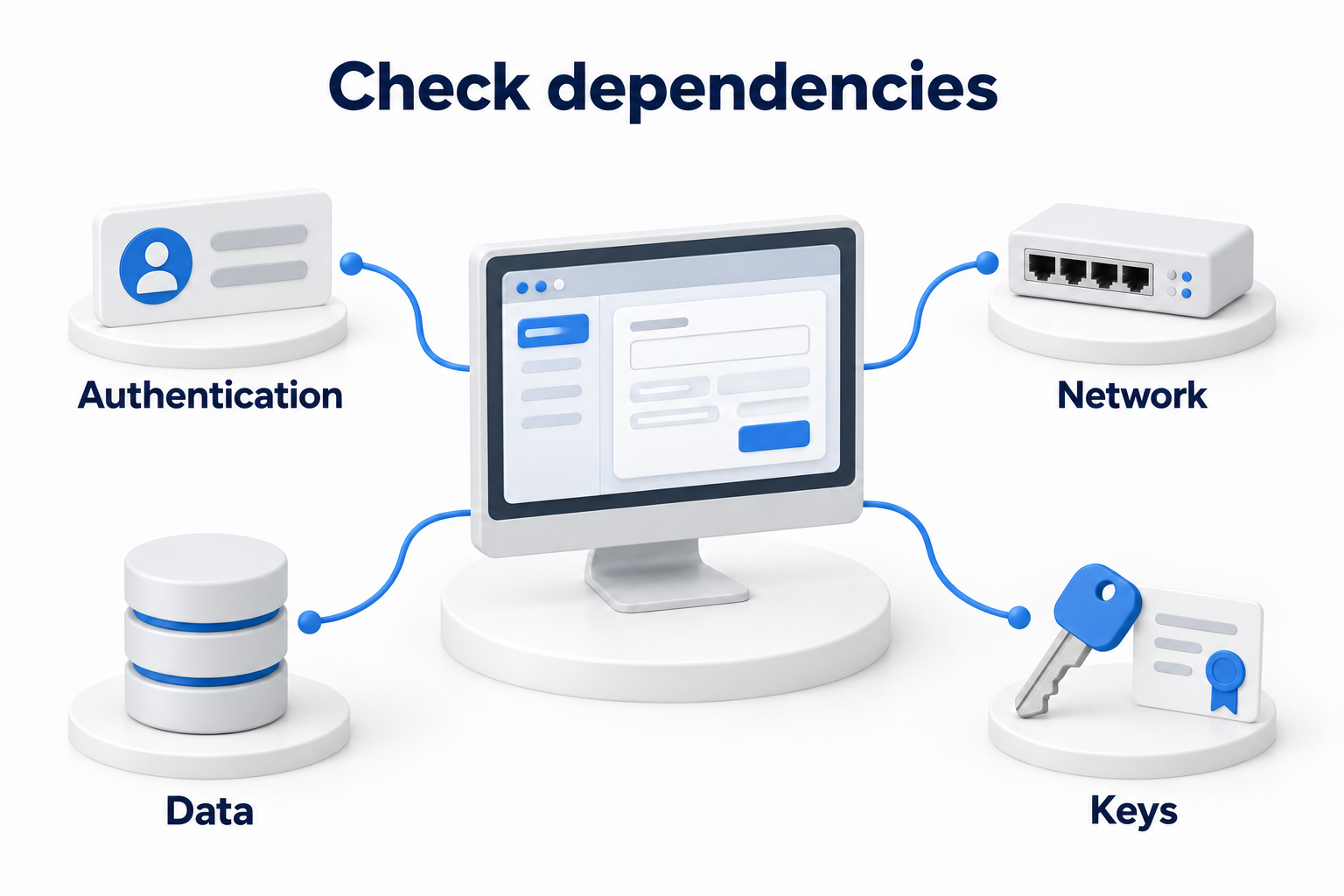
In the cloud, also check availability of the environment, permissions, quotas, resources and recovery mechanisms for the selected workload. For SaaS, clarify data coverage, available operations and service limits. API export speed, key availability and connection bandwidth can change the result. General platform availability does not prove that specific data or applications will recover within the chosen time.
If the process depends on a provider, compare its commitments and verified capabilities with your objective. Allow time to contact the provider, obtain access and restore the integration. One provider's promise does not automatically cover the company's entire chain.
Match the requirement to a feasible option
Stricter objectives may require additional resources, more frequent data protection, a prepared recovery environment and regular testing. Compare options by the required working outcome and total support cost. Do not choose the shortest time just to make a report look good.
If a suitable option exceeds available resources, show management the gap. You can change the scope of the recovered function, improve the technology, prepare a temporary process or agree on another objective. The business owner decides whether to accept the risk. IT must not silently promise an unattainable result.
Zero RPO means no loss of protected changes within the agreed scenario. A label saying continuous backup does not confirm it. Check preservation of committed transactions, the replication method, communication delays and failover behavior. Minimal data loss also does not mean instant service recovery: RPO and RTO remain separate objectives.
Validate objectives through recovery and keep them current
Check more than the backup schedule
A schedule states an intention, not proof. For RPO, check the age of the usable point and preservation of required changes. For RTO, measure the path to a user work action. Retain the test conditions: data volume, available resources, scenario and dependencies. Without them, the next result cannot be compared correctly.
AWS documentation recommends testing the recovery implementation and keeping recovery environment configuration current. Changes in data volume, quotas or resources can invalidate earlier assumptions.
Redundancy, replication and automation can help, but do not independently prove that an objective can be met. Replication can carry erroneous changes. Retrieving data from a protected copy can take time. Evaluate a successful automated test by its coverage rather than treating it as proof against every possible failure.
Record deviations and review the decision
If a target is exceeded, record the cause, remediation owner and retest deadline. If a dependency caused the delay, do not focus only on loading the backup faster. The fix should shorten the stage that actually delayed the working outcome.
Review objectives and evidence after significant changes: a new application, data growth, a provider change, a process change or an incident. Also set a scheduled review date for your company's conditions. Another organization's recommendation to test everything quarterly does not create a mandatory schedule for every environment.
To complete the discussion, you need an approved matrix, clear measurement boundaries, verified dependencies and a recent recovery result. RPO and RTO then become practical criteria for selecting changes and making decisions, rather than just two acronyms in a contract.
Need to compare objectives with your backup system? Contact DKs Enterprises about backup and disaster recovery. Prepare a list of important services, their dependencies and recent test results to discuss the required work.